Product description
Hardcover, format: 21 x 30 cm, 40 pages


120,00 CZK
In stock
Hardcover, format: 21 x 30 cm, 40 pages
| Weight | 0,12 kg |
|---|
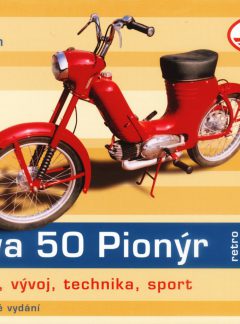
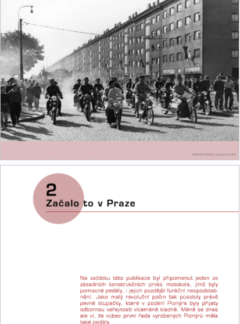
The second edition of this unique publication supplements and clarifies some previously published facts about the history and technical parameters of this small-displacement motorcycle. The history of the very latest machines from the World Championship is newly recalled and data on current activities on the racing field are added. This edition contains more than half of the new, previously unpublished photographs.
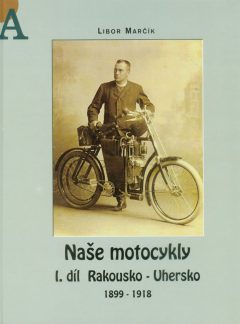
The publication captures almost unknown manufacturers and brands of motorcycles that were produced in the territory of the then Austria-Hungary. The reader will discover an incredible number of motorcycle manufacturers built in the vast majority of only one or a few pieces. Rapid changes in the development of motorcycle design are evident when compared with today's two-wheeled vehicles produced in large series. The publication is important in content for all friends of motorcycle history and the present.
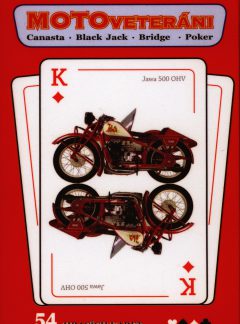
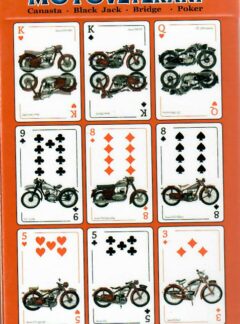
54 playing cards with photos of vintage motorcycles.
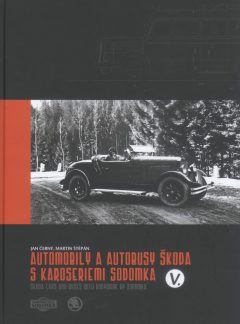
The fifth volume, prepared by a proven pair of authors in the same style as the previous four publications. The content mainly includes original black-and-white company photographs, a significant part of which is published for the first time. Copies of period prints, production drawings, dimensional sketches, business and custom books, business correspondence and original technical descriptions of individual types are supplemented with subtitles and texts in Czech and English. The book, rich in content and volume, is a joy for anyone who owns the previous four volumes and promises further volumes introducing other production brands equipped with bodies from the Sodomka company from Vysoké Mýto.
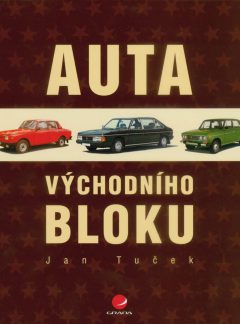
Škoda, Tatra, Trabant, Wartburg, Polski Fiat, Dacia, Oltcit, Moskvich, Lada, Volga and other brands were an integral part of the pre-November era. Sometimes we turned our noses up at them and longed for something better. However, most of us had no choice. Today we can laugh about it, but we should not forget. Not only about that time, but also about the cars we drove back then.
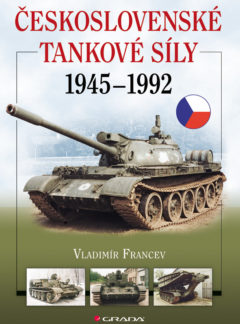
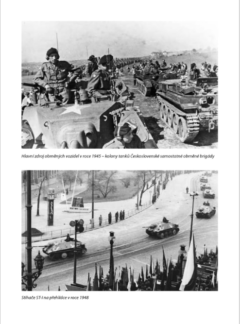
The author, who has already made his mark on readers' consciousness as a specialist and expert in mobile military equipment through the content of previous publications, has compiled an almost fifty-year history of tank units that formed the main striking force of the post-war Czechoslovak army. The text describes the individual phases of the development of armored vehicles in terms of design and progress, production base, organizational structure and expected use. Above all, political aspects influenced the development, production and internal army organization, but also the entire operation of the national economy, which in peacetime produced hundreds of tanks during the year at high financial costs and human resources. Statistics of domestic production with stunning numbers prove possible competition with the largest superpowers, such as the then USSR and the USA. The clear chronological form of the individual types, as well as the entire content of the new book, will refresh the memories of all who have mastered the described equipment, will delight experts, historians and expand the knowledge of fans and members of military clubs.
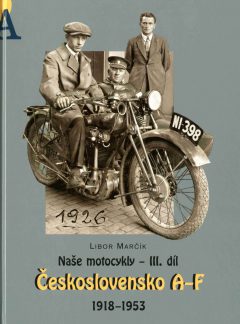
Libor Marčík has already proven his authorial qualities in two previous works on motorcycle history and, in addition to his two recent publications, is now publishing, again at his own expense, another descriptive continuation of Czechoslovak motorcycle history. Years of painstaking work searching in the period press, in state and private archives, as well as examining entries in Latin, German or even in Hungarian-written books written in many registries are rewarded on graphically well-crafted pages. Long-forgotten manufacturers who sought ways of technical development through piece production are listed alphabetically. The carefully crafted text, supplemented by many original photographs, will delight historians and laymen alike, and in the company of the previous two works, a hint of a future complete history of motorcycle production from the times of the Austro-Hungarian Empire to the Czech Republic will begin to emerge in many libraries.
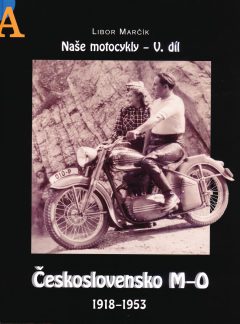
A wide period from the establishment of an independent republic through the years of economic crisis, the protectorate and up to 1953, when a classless society was fully built with the help of obligations - these are the years that the author chose for the next presentation of some motorcycle manufacturers. The author filled the clearly arranged pages of the next part of his extensive publication with the production marks or surnames of workshop owners that begin with one of the three letters M, N, O. Period print, brochures, drawings, dimensional sketches, photographs, official documents replacing technical certificates and other archive materials were suitably used to bring the history of motorcycle production in Czechoslovakia closer. The author has been a guarantee of extremely interesting discoveries with a specialization in two-wheeled vehicles for many years.