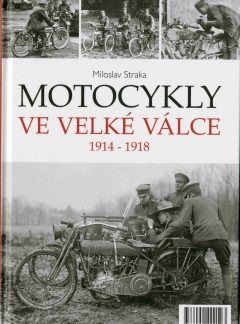
Motorcycles in the Great War 1914 – 1918, Miloslav Straka
Another in a series of works by the renowned author deals with motorcycle history again, this time against the backdrop of World War I. It is published at a time when a hundred years have passed since its course, and the consequences of which fatally influenced the further development of all sectors in Europe. The book is not a historical study of the war, but has the ambition to present the role of motorcycles and the soldiers who served with them in the war. Motorcycles in the Great War performed a number of specific tasks. In addition to the very important courier service, they also served in ambulance and reconnaissance services. Armies used motorcycles on almost all battlefields, but the largest number was on the Western Front on the side of the Allies. The book introduces readers to individual variants of military machines, technical details, a detailed description of the most used models and the history of the brands represented. The publication brings a lot of interesting information not only to our regular fans of motorcycle history, but should also appeal to fans of military history and militaries in general.
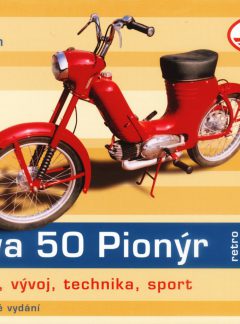
Jawa 50 Pioneer – history, development, technology, sport – 2nd, expanded edition, Jiří Wohlmuth
The second edition of this unique publication supplements and clarifies some previously published facts about the history and technical parameters of this small-displacement motorcycle. The history of the very latest machines from the World Championship is newly recalled and data on current activities on the racing field are added. This edition contains more than half of the new, previously unpublished photographs.
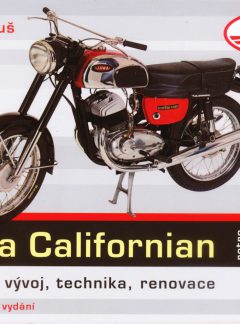
Jawa Californian – history, development, technology, renovation – 2nd expanded edition, Jiří Bartuš
Jawa Californian – motorcycles that, with some exceptions, were intended only for foreign customers, leave hardly any one-track fan indifferent. The second edition of the successful publication will reveal what preceded their creation, how they developed and what influenced the sale of motorcycles from Czechoslovak manufacturers to the North American continent since 1945.
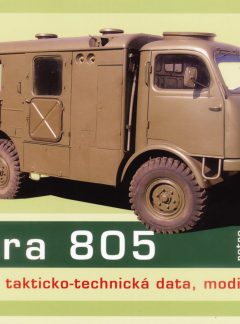
Tatra 805: history, tactical-technical data, modifications, Jiří Frýba
The Tatra 805 light truck was developed in the early 1950s – at a time when the whole of Europe was slowly recovering from the consequences of World War II. The first pages will acquaint readers with the then level of motorization of our army, which primarily initiated the need for a mobile 1.5-ton vehicle. In addition to the basic versions of the flatbed and box, other single-purpose superstructures were built on the existing chassis to perform specific army tasks. The comprehensive text will explain to readers what individual designations such as Šárka, Jarmila, Ezop, Mozek, Třinec and Neděle meant. The difficult-to-understand delimitations and transfers of the final assemblies of the T 805 between production plants are still evidence of „planned“ mistakes. Previously unpublished photographs, clearly arranged technical tables and drawings will remind witnesses of the „eight hundred and five“ from common army and civilian versions to unknown prototypes. The publication will help readers of younger generations understand technical possibilities in the context of the time.
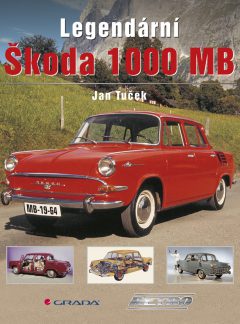
The legendary Skoda 1000 MB
For readers interested in the history of motoring, a book about the development, preparation and mass production of the Czech passenger car has been prepared on the occasion of the 50th anniversary of the Škoda 1000 MB. The first part contains a brief recapitulation of the post-war predecessors from 1946 to 1964. A number of previously unpublished photographs will present prototypes and serial "thousands". The content offers high-quality and verified information about technical parameters, interesting facts from production, the number of units produced for the domestic and foreign markets, and sporting successes.
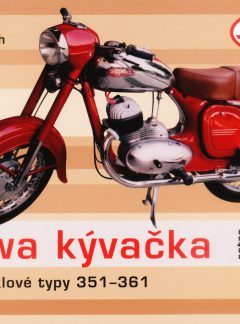
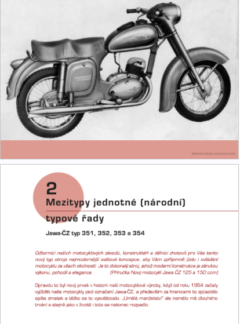
Jawa rocker: motorcycle types 351-361, Jiří Wohlmuth
„"Kývačky" were in production since 1954. In the beginning it was a motorcycle of modern design and due to the limited range of offer it became the most widespread type on domestic roads. The chassis was universal, suitable for mounting two-stroke air-cooled engines of five displacement classes.
The first pages of the book contain a brief introduction with a quick overview of pre-war production. The rest of the content will enlighten the reader about the extensive history with period photographs of prototypes, dimensional sketches, photographs of sports and civilian versions from period newspapers, and detailed descriptions of the differences between the individual types. The chapters also focus on important figures involved in development and production, motorcycle racers of all categories, sales abroad, and the book also contains a reprint of part of the manual, copies of period brochures, and extensive technical tables.
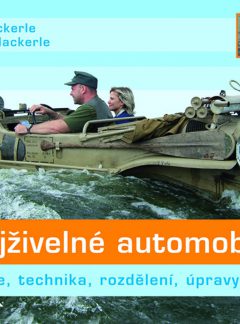
Amphibious cars: history, technology, classification, modifications, Ivan Mackerle
The automobile has always belonged on the road. From the very beginning, when it came into practical use, there were also daredevils who, after modifications, tried to conquer water on their own. The publication is a guide with illustrations, but also an encyclopedia of amphibious vehicles. It maps the area of military, off-road and passenger vehicles capable of overcoming watercourses under their own power. This part of automotive history and the present has not yet been processed on the domestic book market. The content explains the theoretical foundations of vehicle movement in water, through the history of the emergence of amphibians to the technical parameters of military, off-road and passenger amphibious vehicles from the pre-war period to the present. The authors also recall remarkable amateur creations and expeditions. Recommended reading for adventurous natures, but perhaps also a non-standard topic for planning a vacation for next year.
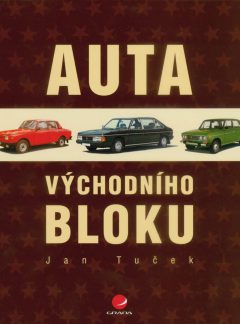
Cars of the Eastern Bloc, Jan Tuček
Škoda, Tatra, Trabant, Wartburg, Polski Fiat, Dacia, Oltcit, Moskvich, Lada, Volga and other brands were an integral part of the pre-November era. Sometimes we turned our noses up at them and longed for something better. However, most of us had no choice. Today we can laugh about it, but we should not forget. Not only about that time, but also about the cars we drove back then.
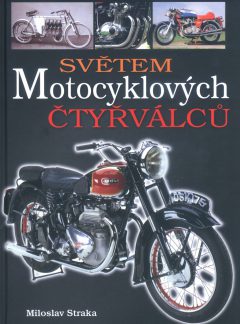
The world of four-cylinder motorcycles, Miloslav Straka
The author has compiled the history of the development and production of four-cylinder engines for motorcycles from the first preserved types. After a three-page introduction to the subject, there is the first of the structurally interesting motorcycles with a four-cylinder engine, where we also have a proud world first: the Laurin & Klement with an in-line four-cylinder engine made in Austria-Hungary. From a chronological perspective, various design directions are interesting, often avant-garde, but also some less fortunate ones, which were often limited by the possibilities of workshop processing. The theoretical idea of the designer was timeless, but the appropriate technology had not yet been produced. Detailed technical descriptions of another twenty-five structurally interesting motorcycles of often no longer existing production brands will certainly interest readers of all age groups.
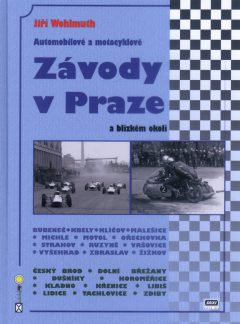
Automobile and motorcycle racing in Prague and the surrounding area, Jiří Wohlmuth
The author has been around road racing tracks since he was a boy. For just as long, he has been trying to extract from eyewitnesses the preserved memories, which are often contradictory. The long-standing idea of processing the "racing" part of the region's history received its final impetus this August at the Strahov Circuit. Going through his own extensive archive, he mobilized close friends and eyewitnesses, and delved into the ČTK archive to process the materials in the evenings. The result, delivered by the publisher in record time to bookshop shelves, will delight friends, fans and eyewitnesses of car and motorcycle racing. A number of previously unpublished facts and photographs will reveal completely new information about sporting events that have always attracted many competitors and spectators. Get yourself a wonderful read for long winter evenings.
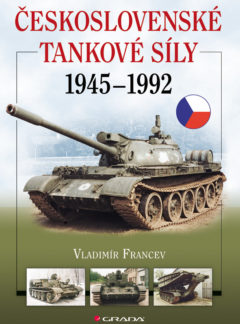
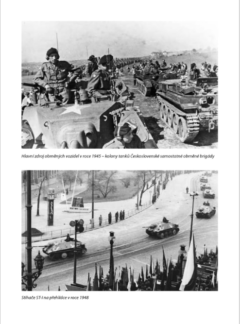
Czechoslovak Tank Forces 1945 – 1992, Vladimír Francev
The author, who has already made his mark on readers' consciousness as a specialist and expert in mobile military equipment through the content of previous publications, has compiled an almost fifty-year history of tank units that formed the main striking force of the post-war Czechoslovak army. The text describes the individual phases of the development of armored vehicles in terms of design and progress, production base, organizational structure and expected use. Above all, political aspects influenced the development, production and internal army organization, but also the entire operation of the national economy, which in peacetime produced hundreds of tanks during the year at high financial costs and human resources. Statistics of domestic production with stunning numbers prove possible competition with the largest superpowers, such as the then USSR and the USA. The clear chronological form of the individual types, as well as the entire content of the new book, will refresh the memories of all who have mastered the described equipment, will delight experts, historians and expand the knowledge of fans and members of military clubs.
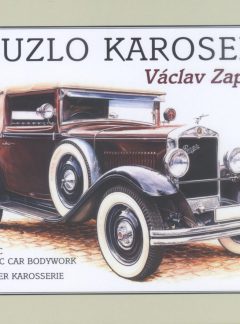
The magic of bodywork – Václav Zapadlík
Maestro Zapadlík has finally been persuaded and, with the help of friends, has created a review of his own works. In the first lines he defends the motivation for creating another pleasing work, which is still not a comprehensive review of his entire work. The Maestro stated literally: "„The publication was inspired by the response of those readers who appreciate the drawing in its often simple line. Therefore, the decision to publish the drawings that were created for a number of magazines more than twenty years ago is a kind of retrospective. In times when the reproduction of an image was difficult and often on very poor quality paper, black and white drawing was probably a good solution for illustrating sometimes even the technical details of cars and their parts.“Views of the delicate shapes of Zapadlík's car bodies can transport the reader to another world and influence aesthetic perception.
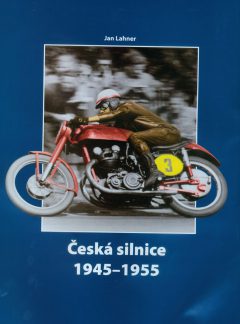
Czech Roads 1945 – 1955, Jan Lahner
A lifelong passion for motorcycle racing, careful study of archives, collection of memories of eyewitnesses and period photographs, programs of long-forgotten races and newspaper clippings, translated into clearly arranged 270 large-format pages in hardcover. This is what Jan Lahner's magnum opus, Czechoslovak Roads 1945-1955, looks like. Renowned motoring historian Jan Lahner has compiled a unique work documenting motorcycle racing on our roads in the first post-war decade. Each year of this period is dedicated to one chapter, describing in detail individual motorcycle races. Each chapter is supplemented by biographies of the racers who met in those years on road races and formed the top of the time. The lives of racers such as Kostlivec, Bubeníček, Lucák, Dusil, Kněz, Jiří and Jaroslav Simandl, or Jiří Koštíř and many others have not yet been published anywhere. Similarly, many of the more than 600 black and white photographs contained in the book have not yet been known to the public. The last chapters contain technical descriptions of interesting racing motorcycles and a clearly arranged table of all recorded race results.
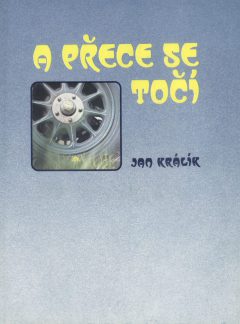
And yet it spins, Jan Králík
New book from the warehouse.
The author, in his own unique way, expressed his admiration for the Sisyphean effort of all collectors and renovators of cars, buses, motorcycles or stationary engines, for their lifelong toil, which at the very end of this journey we can admire and say that our grandfathers knew how to make it, after all, that machine actually has a soul... The fates of these passionate fans and their collections are all the more interesting because after 30 years a lot has changed. Jiří Wagner accompanied the book with his photographs.
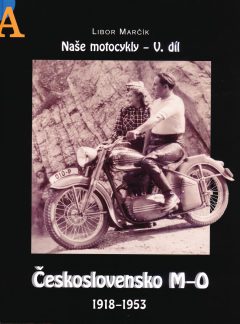
Our Motorcycles – Part V Czechoslovakia MO 1918 – 1953, Libor Marčík
A wide period from the establishment of an independent republic through the years of economic crisis, the protectorate and up to 1953, when a classless society was fully built with the help of obligations - these are the years that the author chose for the next presentation of some motorcycle manufacturers. The author filled the clearly arranged pages of the next part of his extensive publication with the production marks or surnames of workshop owners that begin with one of the three letters M, N, O. Period print, brochures, drawings, dimensional sketches, photographs, official documents replacing technical certificates and other archive materials were suitably used to bring the history of motorcycle production in Czechoslovakia closer. The author has been a guarantee of extremely interesting discoveries with a specialization in two-wheeled vehicles for many years.
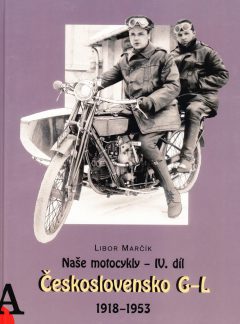
Our Motorcycles – Part IV Czechoslovakia GL 1918 – 1953, Libor Marčík
Another part of the extensive work of the author and historian. Already on the page with the contents, the reader will find out that in a sector of only seven letters in alphabetical order, there were 72 motorcycle brands operating in our republic. Small locksmith workshops that produced a single motorcycle or applied a drive unit to a bicycle frame are also captured. Rarely preserved materials have been enriched here with high-quality processing, from graphic preparation to the selection of materials used. The publication will once again significantly advance detailed knowledge of the history of motorcycle production. Libor Marčík's representative publications are always a suitable gift for all motorists, regardless of age or focus.
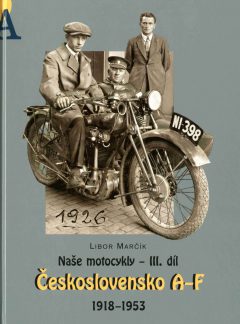
Our Motorcycles – Part III Czechoslovakia AF 1918 – 1953, Libor Marčík
Libor Marčík has already proven his authorial qualities in two previous works on motorcycle history and, in addition to his two recent publications, is now publishing, again at his own expense, another descriptive continuation of Czechoslovak motorcycle history. Years of painstaking work searching in the period press, in state and private archives, as well as examining entries in Latin, German or even in Hungarian-written books written in many registries are rewarded on graphically well-crafted pages. Long-forgotten manufacturers who sought ways of technical development through piece production are listed alphabetically. The carefully crafted text, supplemented by many original photographs, will delight historians and laymen alike, and in the company of the previous two works, a hint of a future complete history of motorcycle production from the times of the Austro-Hungarian Empire to the Czech Republic will begin to emerge in many libraries.
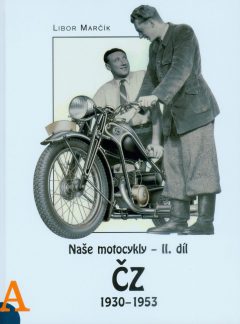
Our Motorcycles – Part II ČZ 1930 – 1953, Libor Marčík
The text presents the history of motorcycle production in Strakonice in the period mentioned. It captures the development and production of individual types in technical data, taking into account design innovations, equipment and numbers of units produced. A unique and down to the smallest, seemingly insignificant details, description of individual motorcycle types from the first motorized bicycle to the last post-war type. A book that every history expert and owner of more than two motorcycles should have for everyday use.
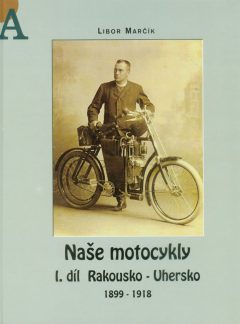
Our Motorcycles Part I Austria-Hungary 1899 – 1918, Libor Marčík
The publication captures almost unknown manufacturers and brands of motorcycles that were produced in the territory of the then Austria-Hungary. The reader will discover an incredible number of motorcycle manufacturers built in the vast majority of only one or a few pieces. Rapid changes in the development of motorcycle design are evident when compared with today's two-wheeled vehicles produced in large series. The publication is important in content for all friends of motorcycle history and the present.
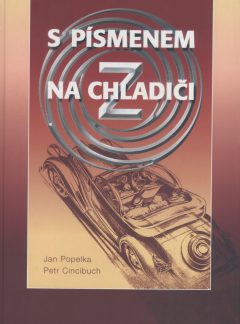
With the letter Z on the radiator, Jan Popelka and Petr Cincibuch
Unium Publishing House, hardcover, format 21.5 x 30 cm, 160 pages. ISBN: 80-902542-2-5.
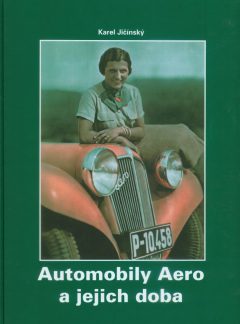
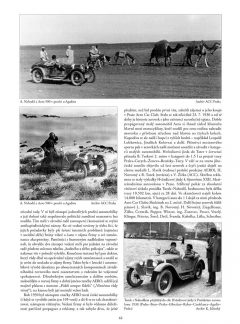
Aero cars and their era, Karel Jičínský
Descriptions of individual types, copies of drawing documentation and a number of original photographs, placed in the context of the time, have created an engaging document. The author has long been dedicated to collecting materials directly related to the Aero brand, and has put this many years of activity to good use in a publication that should not be missing from the library of any aero enthusiast.
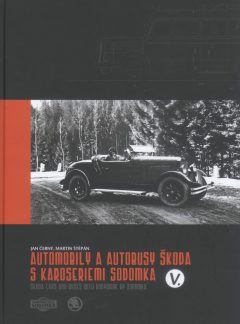
Škoda cars and buses with Sodomka bodies, part V, Martin Štěpán and Jan Černý
The fifth volume, prepared by a proven pair of authors in the same style as the previous four publications. The content mainly includes original black-and-white company photographs, a significant part of which is published for the first time. Copies of period prints, production drawings, dimensional sketches, business and custom books, business correspondence and original technical descriptions of individual types are supplemented with subtitles and texts in Czech and English. The book, rich in content and volume, is a joy for anyone who owns the previous four volumes and promises further volumes introducing other production brands equipped with bodies from the Sodomka company from Vysoké Mýto.
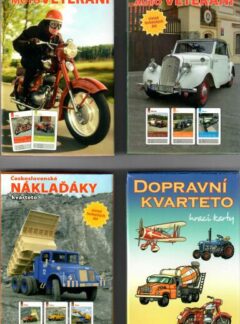
Quartet
32 playing cards with pictures of vintage vehicles. The game includes instructions.
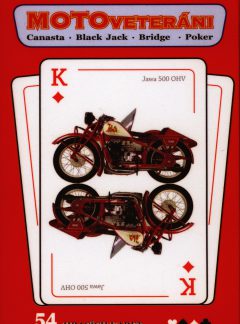
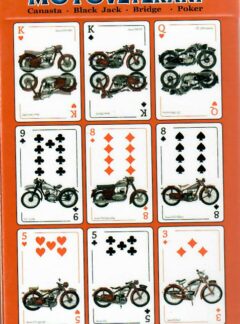
Canasta cards Moto veterans
54 playing cards with photos of vintage motorcycles.
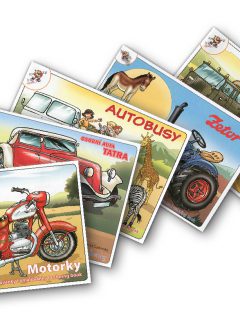
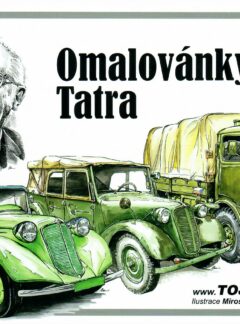
Coloring book
Coloring book containing 8 colorful images of historical vehicles.
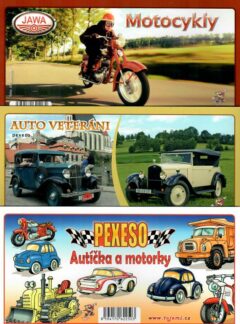
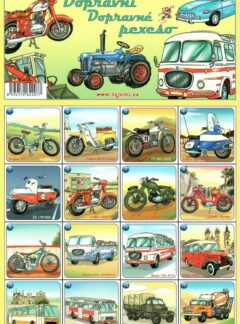
Memory game
Memory game consisting of 32 pairs of photographs of historical means of transport.
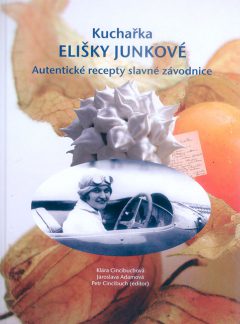
Cookbook by Eliška Junková, Klára Cincibuchová and Jaroslava Adamová
Eliška Junková as we don't know her! Taste buds are properly activated by the content divided into four separate sections: appetizers, soups, main courses and desserts. Between each course there is always a double page of copies taken from the original photographs from Mrs. Eliška's family album. Color photographs of the finished dish are supplemented on each page with brief, concise instructions on how to gradually process the ingredients. A motorist doesn't just live on gasoline - and what's more, Mrs. Eliška moved among men and knew what makes a success on a plate. Thank your partner for their year-round care with a nice book under the Christmas tree.